

Divine Intervention in AI
President Trump calls the Pope "weak", but the truth is, Pope Leo is asking the right questions about AI.

Ten years ago, if you’d told me the Pope would become one of the most thoughtful voices in the global technological debate, I would have raised an eyebrow.
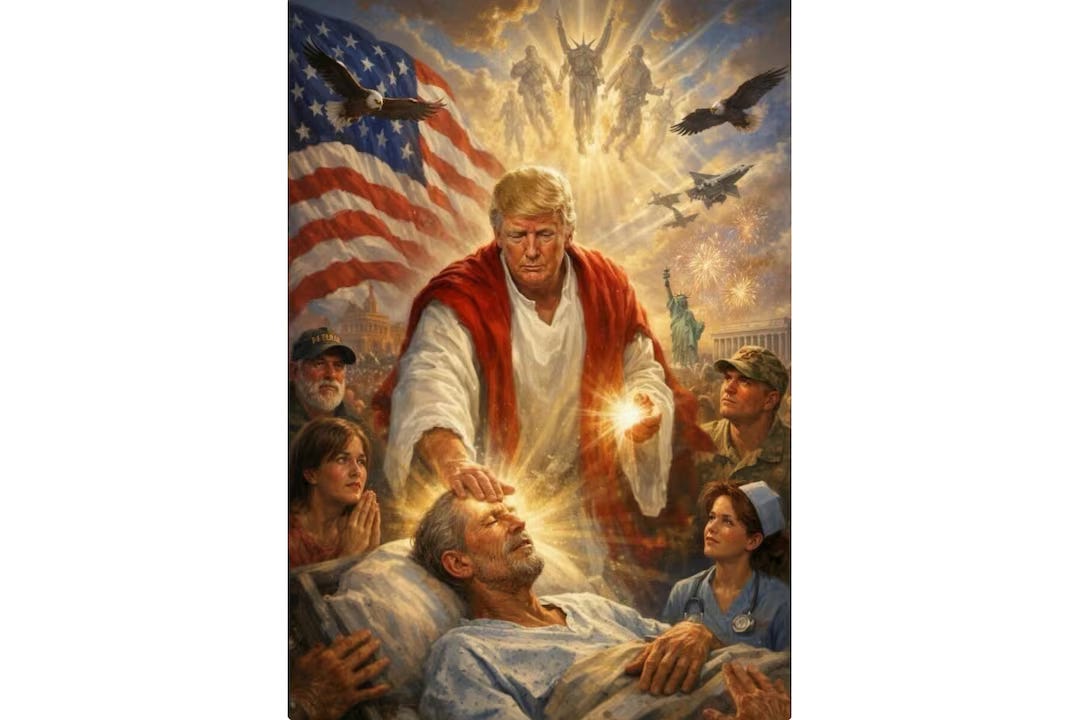
Speaking to students in Cameroon, Pope Leo warned that AI risks “hollowing out” real human relationships—creating digital environments where people are optimized into bubbles, unable to distinguish truth from simulation. Around the same time, he was publicly criticizing the U.S. administration’s military threats against Iran, prompting President Trump to fire back on Truth Social and call him “weak.” Trump then posted an AI-generated image of himself as Jesus, and deleted it after backlash from across the political spectrum.
It’s a strange constellation of events. But underneath it is a single, important inflection point: world leaders—religious and political—are now openly fighting about what it means to be human in the age of AI. And Pope Leo, more than most, is asking exactly the right question. Pope Leo even chose his name as a deliberate echo of the industrial-revolution-era Pope Leo XIII, who confronted the human consequences of the last great technological upheaval. The name itself is a thesis: this is the moment, and we have to steer it.
Pope Leo is right to say that if we build AI that flatters and isolates (e.g., “you’re so spectacular, you’re right all the time, don’t talk to other people, only talk to me”) then we have made humanity smaller. Some systems already drift in that direction. But this is a design choice, not a foregone conclusion. For example, when we built Pi at Inflection, we made the opposite call by default, and built the chatbot to encourage the user to find more real-world social connections. The idea was that EQ matters as much as IQ—and that the best AI doesn’t replace humans with a chatbot. It helps you show up more fully, for more people.
I’m an optimist, and I try not to let that descend into naivete. The “natural” trajectory of any powerful technology isn’t utopia; it’s whatever the most motivated incentives drive it toward. Those incentives come from a set of quasi-religious beliefs that exist within Silicon Valley.
The religious factions that end up winning and thus ingraining their values into the products we use will decide whether or not we have a smoother transition into the beneficial world of AI, or if, like the Industrial Revolution, humanity makes it through, albeit with unnecessary chaos and collapse of institutions. Getting to the positive future requires a full-court press from all those who believe it is possible. That means builders, investors, influencers, and governments building demand for what good looks like, and following through on their promises.
So when Pope Leo speaks, I’m not hearing him as a cultural curiosity in the AI conversation. I’m hearing him ask the question every technologist should have on their desk, at their fingertips, and top of mind: What is the human answer here?
PS: This is my third substack! I’ve been so grateful for the thoughtful comments so far, and plan to respond to as many as I can (albeit slowly). Feel free to let me know your thoughts on Pope Leo or recommend some new topics you’d like to see me write on!
I think this comment deserves thought:”The “natural” trajectory of any powerful technology isn’t utopia; it’s whatever the most motivated incentives drive it toward. “ It is the entropy of Silicon Valley.
It seems like humans need purpose. Many tie their purpose to work which AI threatens.
The Pope can offer another purpose. New age purpose will certainly be a fun topic of debate - maybe even worth an article :)